
All on Six and All on Four Treatment
"All-on-Six" treatment is a dental procedure that provides a full arch restoration for patients who have lost most or all of their teeth in the upper or lower jaw. It is a variation of the popular All-on-4 treatment concept.
All-on-Six treatment involves the placement of six dental implants in the jawbone to support a fixed dental bridge or denture. The implants are strategically positioned to maximize the stability and support of the prosthetic teeth. The name "All-on-Six" refers to the fact that all the teeth in the arch are supported by these six implants.
The basic steps involved in All-on-Six treatment are as follows:
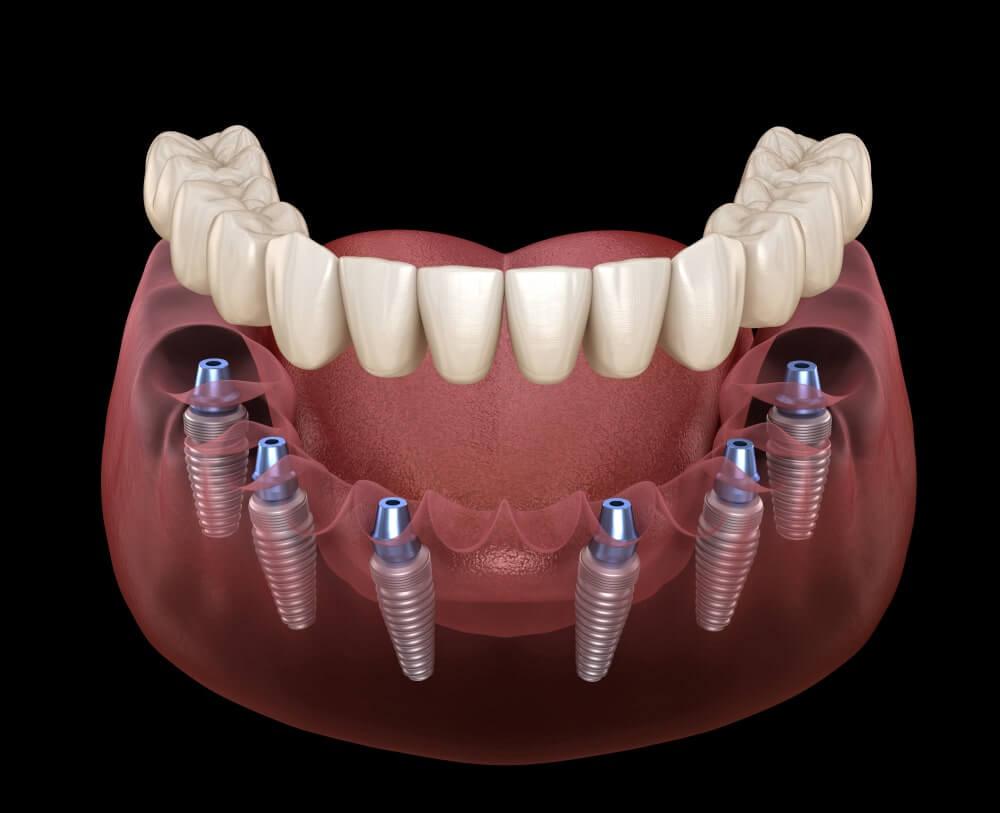
- Initial consultation: A comprehensive examination of your oral health, including dental x-rays, impressions and possibly a CT scan.
- Treatment planning: The dentist or oral surgeon will plan the optimal placement of the six dental implants based on the condition of your jawbone and the desired outcome.
- Implant placement: Dental implants are surgically placed into the jawbone under local anesthesia or sedation. The implants need time to integrate with the bone through a process called osseointegration, which usually takes several months.
- Temporary restoration: In some cases, a temporary prosthesis or bridge is placed over the implants to provide aesthetic and functional support during the healing process.
- Final Restoration: After the implants have fully fused with the jawbone, the temporary restoration is replaced with a customized, permanent dental bridge or denture. The final restoration is designed to look and function like natural teeth.
All-on-Six treatment offers several advantages over traditional removable dentures, including improved stability and chewing function. Six implants are used to create a strong foundation for the prosthetic teeth and better distribution of forces during biting and chewing.
It is important to note that the specific details of All-on-Six treatment may vary depending on the individual's condition and the recommendations of the dentists involved. If you are considering this treatment, it is best to consult a qualified dentist or oral surgeon who can assess your oral health and provide personal guidance.
All on Four Treatment
All-on-4 treatment, also known as "Teeth in a Day", is an implant procedure designed to place a full arch denture using only four dental implants. It is a popular and effective solution for people who have lost most or all of their teeth in the upper or lower jaw and want a fixed, long-term dental restoration.
An overview of the All-on-4 treatment process:
1. Assessment and Treatment Planning: The first step involves a thorough examination of your dental condition. This may include X-rays, CT scans and digital impressions to assess bone density and determine the ideal placement of dental implants.
2. Extraction (if necessary): If the remaining teeth need to be extracted, they are extracted in preparation for implant placement.
3. Implant Placement: Four dental implants are strategically placed in your jawbone. Typically, two implants are placed vertically in the front of the jaw, while two implants are angled toward the back of the mouth. This angulation maximizes contact with existing bone and in many cases eliminates the need for bone grafting.
4. Temporary Restoration: After the implants are placed, a temporary dental prosthesis (bridge) is placed on the same day. This temporary restoration allows you to have functional teeth while the implants integrate with the bone.
5. Healing Process: Over the next few months, a process called osseointegration takes place, during which the implants fuse with the jawbone, providing stability and support.
6. Final Restoration: Once the implants are fully osseointegrated, the temporary bridge is replaced with a custom-designed permanent denture. This final restoration is made to match your natural tooth in terms of aesthetics and functionality.
All-on-4 treatment offers several advantages, including reduced treatment time and costs compared to traditional implant methods. In many cases, it also eliminates the need for bone grafting, as the angled placement efficiently utilizes existing bone.
It is important to remember that each patient is unique and treatment plans may vary according to individual circumstances and the recommendations of the dentist performing the procedure. Consulting with a dentist or prosthodontist who specializes in implant dentistry to determine if All-on-4 treatment is suitable for your case ensures you get the best solution.